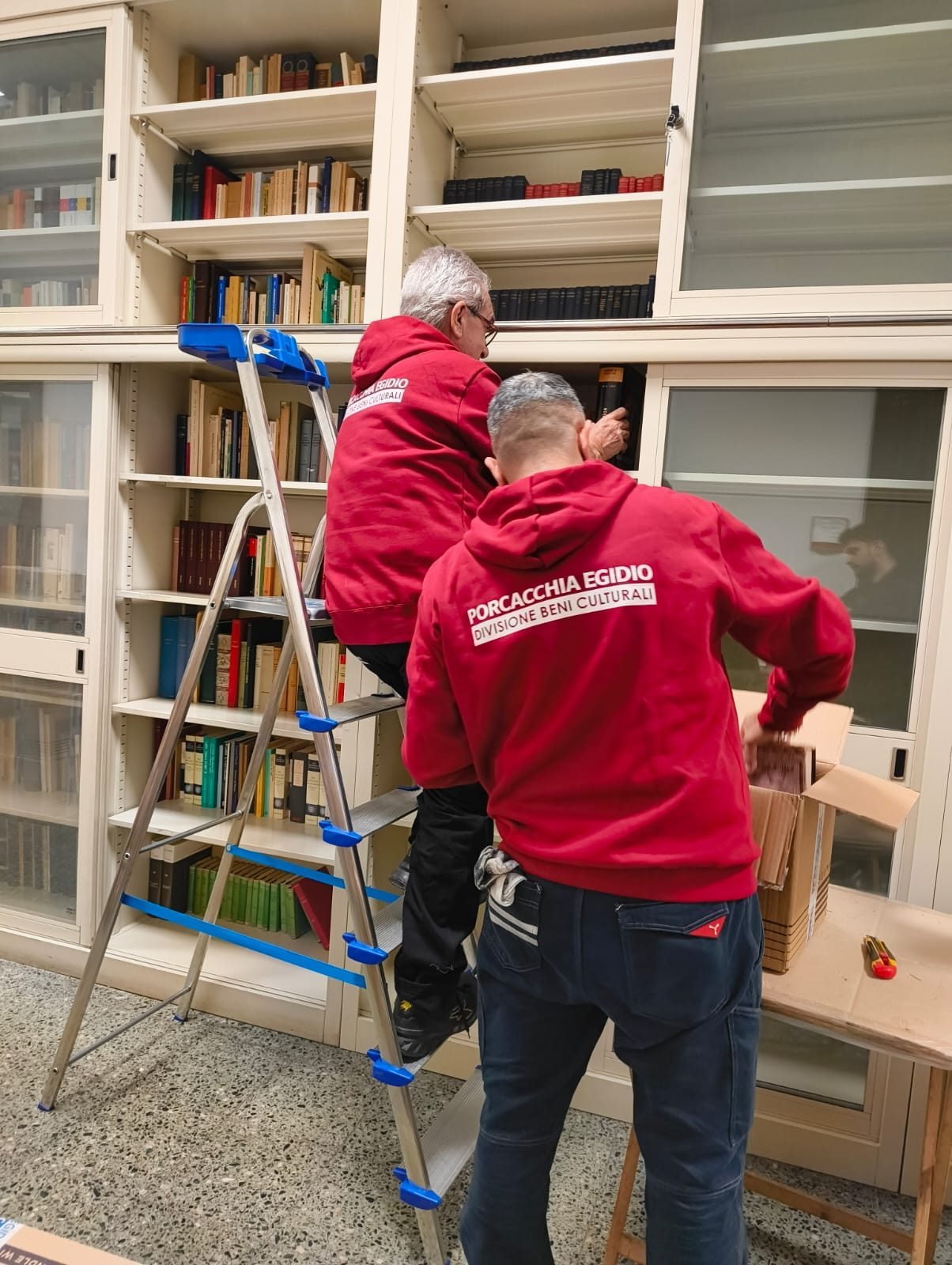
Moving an archive or a library is not like an ordinary relocation
The transfer of archival or library material — especially material of historical or cultural value — requires planning that goes well beyond simple physical relocation. Every document must be catalogued, every box labeled, every stage of the journey documented.
For public institutions, archive and library transfers often take place in the context of building renovations, office relocations, or space rationalization — often with deadlines imposed by third parties (construction work, auctions, tenders). In these scenarios, the provider's experience is not optional: it is the difference between a successful transfer and the irreversible loss of historical documentation.
Since 1950, we have transferred archives for hundreds of institutions — ministries, municipalities, foundations, notarial offices — without ever losing or damaging material entrusted to us.
A structured working system
Every archival or library unit is inventoried and numbered for rapid identification of each package.
The process in 7 phases
Site survey and operational plan
Assessment of volume, material condition, access points, and distances. Production of an operational plan with phases, timelines, and required resources.
Inventory
Every unit is catalogued and a copy of the inventory is delivered to the client.
Specialized packing
Suitable, state-of-the-art boxes, rigid containers for photographs and photographic material. Visual marking of fragile batches.
Loading onto company-owned vehicles
On request, batches are photographed at loading. The vehicles used are all box trucks, dry and secure.
Delivery and controlled unloading
Unloading and delivery are carried out with a checklist used to tick off each package, guaranteeing that every single package has been delivered. All services are always carried out in the presence of one of our operators.
Planned and controlled reshelving
Material is positioned according to the agreed placement plan, preserving the original order where required by archival regulations.
Final report and inventory handover
Transfer report signed by both parties, updated inventory in digital and paper format.
"In our sector, organising the work in phases is not optional: it is the key to guaranteeing clarity, control and operational efficiency."
Operational guarantees
All-Risk insurance
Specific insurance coverage for archival material and cultural heritage assets throughout the entire transport phase.
Verifiable inventory
A copy of the inventory will be delivered to the client in paper format and, on request, also as a PDF.
Trained personnel
Only operators with specific training in archival science and cultural heritage handling. No piecework, no unqualified subcontracting.
Deadline compliance
The operational plan includes buffer time for the unexpected. In 76 years of activity, we have never missed an agreed contractual deadline.
Frequently asked questions
Mapping of the original order: before moving the documents, we record the exact arrangement of the folders on the shelves so it can be faithfully replicated at the new destination.
High-resistance boxing: we use dedicated archive boxes in reinforced cardboard, designed to protect paper from dust, impacts and humidity.
Labelling and paper inventory: every box is hand-marked with a clear reference indicating its contents and original location.
Palletising and protection: the packed boxes are placed on pallets, strapped and wrapped in heat-shrink stretch film to guarantee maximum stability during transport.
This simple, secure system perfectly preserves the sequence of the archive, making it possible to find any document immediately.
Factors that influence timing:
Mapping and inventory: if the folders require detailed cataloguing or barcode application, packing times increase slightly to guarantee traceability.
Accessibility of the premises: goods lifts, dedicated elevators or restricted-traffic loading zones considerably speed up handling.
Operational continuity: we can schedule the intervention at weekends or outside working hours so as not to interrupt your company’s activity.